
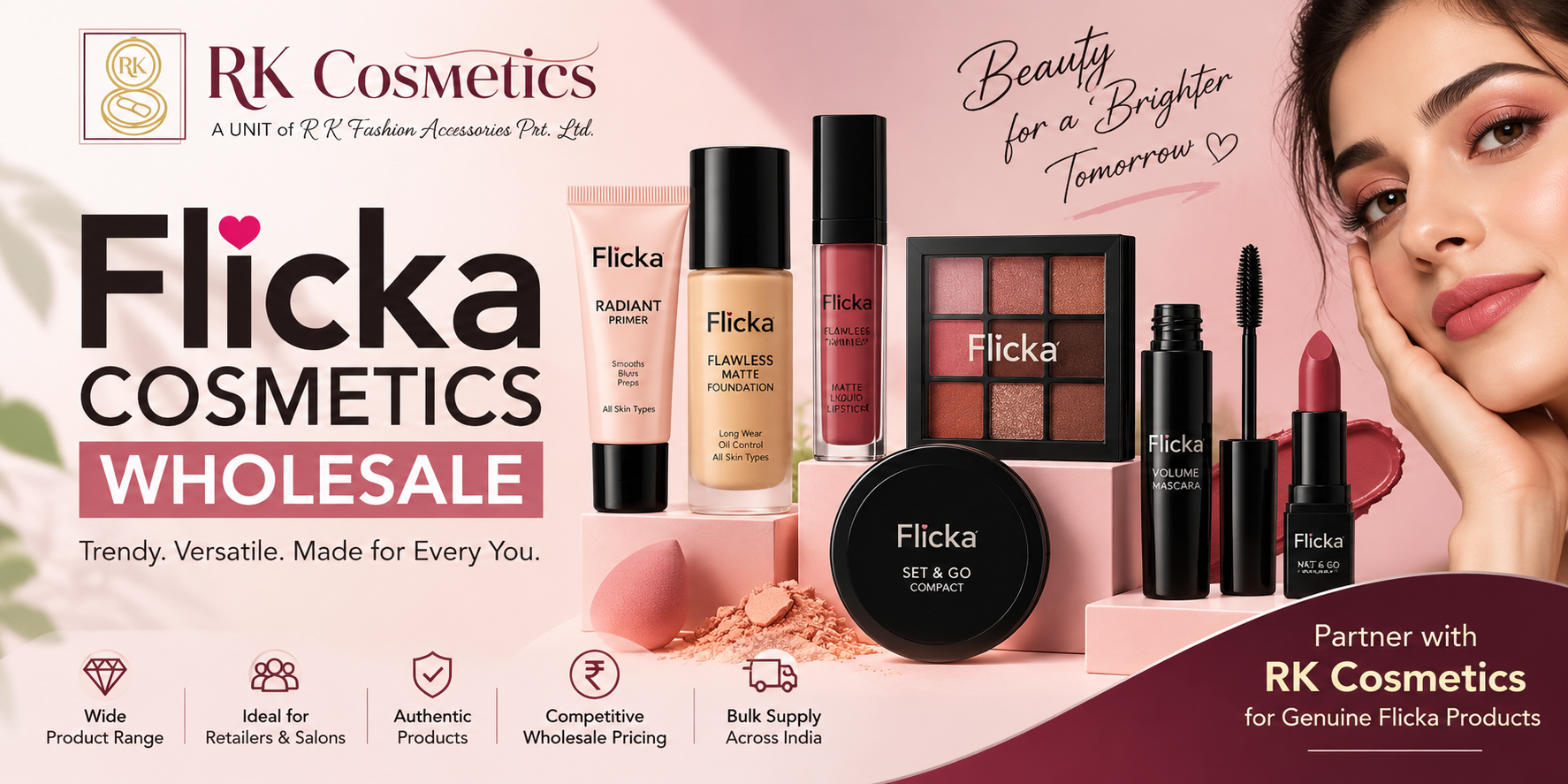
Flicka Cosmetics has built a presence in the Indian makeup market with products across face, lips, eyes, nails and beauty accessories. Its current catalogue includes foundations, concealers, primers, compact powders, lipsticks, lip liners, kajal, mascara, eyeliners, eyeshadow palettes, nail products and makeup tools. The brand also states that its products are designed with Indian skin tones in mind and reports a presence in more than 2,200 retail stores.
For retailers, choosing a dependable cosmetics range is not only about product popularity. It involves checking assortment, shade availability, product documentation, shelf life, pricing structure, packaging, replenishment and customer demand. This guide explains what buyers should evaluate when sourcing Flicka cosmetics wholesale for a retail, salon, online or professional makeup business.
Why do retailers consider Flicka cosmetics wholesale?
A wholesale cosmetics assortment needs to cover different customer requirements without creating excessive inventory. Flicka’s catalogue provides multiple categories that can help retailers build a balanced makeup selection.
Key categories include:
- Face: foundations, primers, concealers, compacts, loose powders, blushers and highlighters.
- Lips: liquid lipsticks, traditional lipsticks, lip liners, lip balms, glosses and lip primers.
- Eyes: kajal, eyeliner, mascara, brow products and eyeshadow palettes.
- Nails: nail polish and nail-removal products.
- Accessories: makeup brushes, beauty blenders and eyelashes.
The current online catalogue lists dozens of products across these categories, although availability and pricing can change.
What products should a retailer buy first?
A new retailer should generally avoid purchasing every SKU immediately. Instead, begin with products that address frequent makeup needs and then expand according to sales data.
A practical starter mix can include:
- Multiple foundation shades suited to the local customer base.
- Popular concealer shades.
- One or two primer options.
- Compact and loose powder.
- Everyday and statement lip colours.
- Kajal and eyeliner.
- Mascara.
- A versatile eyeshadow palette.
- Blusher or highlighter.
- Basic brushes and beauty sponges.
The objective is to create category coverage while keeping slow-moving inventory under control. A well-planned Flicka cosmetics wholesale order should therefore prioritise proven categories before experimental SKUs.
Why is shade selection important?
Complexion products require more careful inventory planning than many colour cosmetics. Foundation and concealer shades can have significantly different demand depending on geography, customer demographics and buying behaviour.
When evaluating Flicka cosmetics wholesale, retailers should examine:
- Number of available shades.
- Undertone options.
- Shade names and numbering.
- Tester availability.
- Return or replacement terms for damaged products.
- Historical sales by shade, if available.
Retailers should also avoid assuming that one shade will suit an entire customer group. Maintaining a measured shade range can reduce both stock-outs and dead inventory.
How should businesses evaluate wholesale pricing?
Wholesale buying should be assessed using total landed cost rather than only the quoted unit price. Total cost can include product price, GST where applicable, shipping, packaging, payment charges and potential handling costs.
Before placing a Flicka cosmetics wholesale order, calculate:
- Cost per unit.
- Minimum order quantity.
- Shipping cost.
- Applicable taxes.
- Expected selling price.
- Gross margin.
- Inventory turnover.
- Promotional discount requirements.
For example, a product with a lower purchase price may not necessarily be more profitable if it sells slowly or requires heavy discounting. Conversely, a slightly higher-cost product can support healthier inventory turnover if customers repeatedly purchase it.
What should retailers check before ordering?
Due diligence is important when buying cosmetics in bulk, particularly when a Flicka cosmetics wholesale purchase involves multiple SKUs or a substantial inventory commitment. Businesses should verify product information and supplier terms before committing significant working capital.
A checklist should include:
- Manufacturer or marketer details.
- Batch number and manufacturing information.
- MRP and applicable regulatory labelling.
- Ingredient information.
- Shelf life or expiry information.
- Packaging condition.
- Invoice and tax documentation.
- Minimum order quantity.
- Delivery timelines.
- Damaged-product policy.
- Replacement or return conditions.
For branded cosmetics, buyers should also confirm that the source is authorised or otherwise able to provide legitimate, traceable stock.
How can online and offline retailers manage inventory?
Inventory planning is one of the most important parts of cosmetics wholesale. Makeup products can have different sales velocities, so retailers should classify SKUs according to demand.
A simple inventory system can divide products into:
- Fast movers: Reorder frequently and maintain safety stock.
- Medium movers: Review weekly or monthly.
- Slow movers: Reduce future purchases and use carefully planned promotions.
- Seasonal products: Increase stock only around relevant demand periods.
Retailers should track SKU-level sales instead of judging performance only by overall revenue. This makes it easier to identify which shades, colours and product categories deserve additional investment on Flicka cosmetics wholesale.
Why does packaging and product presentation matter?
Cosmetics are highly visual products. Customers often assess colour, texture, packaging and shade presentation before purchasing. Retailers should therefore maintain clean displays, clear pricing and accurate product information.
For online stores, useful product pages should contain:
- High-quality product images.
- Shade information.
- Ingredient details where available.
- Net quantity.
- Usage instructions.
- Suitable product category.
- Shipping and return information.
- Clear product titles and descriptions.
Accurate information can reduce customer confusion and unnecessary returns.
How can retailers improve sales after buying wholesale stock?
Buying inventory is only the first step. Retailers can improve sell-through through structured merchandising and content.
Useful approaches include:
- Create face, eye and lip category collections.
- Build beginner makeup kits.
- Cross-sell lipstick with lip liner.
- Pair foundation with concealer and setting products.
- Use short-form videos to demonstrate application.
- Publish shade guides and comparison content.
- Feature customer reviews where permitted.
- Monitor search and sales data to identify demand.
- Run controlled promotions on slow-moving SKUs.
For a wholesale-focused business such as RK Cosmetics, category-based merchandising can also make it easier for retailers to identify suitable products for their stores or online catalogues.
Is Flicka suitable for different types of retailers?
The range can be relevant to several retail formats, but the right assortment depends on the business model.
Potential buyers may include:
- Cosmetic shops.
- Beauty product distributors.
- Salons and makeup studios.
- Online beauty stores.
- Multi-brand retailers.
- Professional makeup artists.
- Local resellers.
A salon may prioritise base makeup, eye products and professional tools, while an online retailer may need a broader shade range and stronger product-page content.
What should businesses consider before scaling orders?
Once initial sales data is available, retailers can make purchasing decisions based on evidence rather than assumptions. Track sales velocity, gross margin, repeat purchases, customer feedback and stock ageing.
When expanding Flicka cosmetics wholesale purchases, consider:
- Increasing quantities only for proven fast-moving SKUs.
- Testing new shades in smaller quantities.
- Maintaining a safety stock for reliable sellers.
- Reviewing expiry dates regularly.
- Negotiating commercial terms as order volume grows.
- Comparing supplier service levels, not only price.
This approach can help businesses control working capital while building a more dependable cosmetics assortment.
Conclusion
Sourcing cosmetics in bulk requires more than finding attractive products at a low price. Retailers need to balance assortment, authenticity, shade availability, documentation, landed cost, shelf life and sales velocity. Flicka’s current range spans face, lip, eye, nail and accessory categories, giving businesses several options for developing a multi-category makeup assortment.
For businesses evaluating Flicka cosmetics wholesale, the most useful approach is to start with a focused assortment, measure actual demand and expand gradually. Whether purchasing for a physical store, salon or e-commerce operation, systematic inventory management can make wholesale buying more predictable and commercially sustainable. Retailers sourcing through RK Cosmetics can apply the same checklist when comparing products, quantities, pricing and replenishment requirements.